What an HPI Check Actually Tells You — And What It Misses
I’m going to tell you something about HPI checks that most buying guides won’t, because most buying guides are written by people who’ve never actually worked on a forecourt.
An HPI check is one of the most important things you can do before buying a used car. Run your own. Always run your own. Never, ever accept one from the dealer. I’ll explain why in a moment — and it involves a dealership I lasted exactly two weeks at before I decided my conscience couldn’t take it.
But first, let’s talk about what an HPI check actually is, what it tells you, and — just as importantly — what it doesn’t.
What is an HPI check?
HPI stands for Hire Purchase Information. The name comes from the original purpose of the database — tracking cars that were subject to outstanding hire purchase finance agreements. It’s grown significantly since then, but finance is still one of its most important functions.
When you run an HPI check on a vehicle, you’re querying a database that pulls together information from multiple sources: the DVLA, finance houses, insurance write-off registers, police databases, and more. The result is a report that tells you, in one place, a range of things that could seriously affect your decision to buy.
If the check comes back clean, HPI backs it up with a guarantee — up to £30,000 — meaning that if the data was wrong and you suffer a financial loss as a result, you’re covered. That guarantee is a significant part of what you’re paying for. It’s not just a report. It’s a degree of financial protection.
What an HPI check tells you
Outstanding finance
This is the big one. If a car has outstanding finance on it — meaning someone borrowed money against it and hasn’t paid it back — the finance company still has a legal interest in the vehicle. You could buy the car in good faith, hand over your money, and then have the finance company come and repossess it. Legally, they’re entitled to. You’d lose the car and have to fight to recover your money.
An HPI check will tell you if there’s recorded outstanding finance against the vehicle. It’s not exhaustive — more on that shortly — but it covers the major lenders and will flag the vast majority of cases.
Written-off status
Cars are written off in categories. Category A and B are the serious ones — the car is damaged beyond economic repair and, in the case of Cat A, should never return to the road. Category S (structural damage) and Category N (non-structural) are less serious — the car can be repaired and returned to use, but the write-off is permanently recorded.
An HPI check will tell you if a car has previously been recorded as a write-off. A Cat S or Cat N car isn’t necessarily a bad buy — plenty of perfectly good cars have been through insurance repairs — but you deserve to know about it, and the price should reflect it.
Stolen vehicle register
The check will flag if the car has been reported stolen. Buying a stolen car — even unknowingly — means you don’t get to keep it. The police will recover it. You lose the car and, in most cases, your money too.
Number plate and VIN checks
The report will highlight if the number plate or Vehicle Identification Number has been flagged as suspicious — potentially indicating a cloned or ringed vehicle. These are relatively rare but represent serious fraud.
Mileage discrepancies
HPI checks include mileage data gathered from MOT records, service history, and other sources. If the recorded mileage history doesn’t match what the odometer says — or shows a suspicious pattern — it’ll show up. Clocked cars are less common than they used to be but they haven’t disappeared.
What an HPI check won’t tell you
This is where it gets important — and where a lot of buyers get a false sense of security.
Uninsured accident damage and repairs
An HPI check only knows about damage that was reported to an insurer and processed through official channels. If a car was repaired privately — cash in hand at a bodyshop, no insurance claim — there will be no record of it whatsoever. The check will come back clean.
This happens more than you’d think. Minor accidents, kerb damage, parking knocks — plenty of these get quietly fixed and never declared. The HPI check won’t help you here. A proper physical inspection will — which is why the check is one part of the process, not the whole thing.
The full service history picture
HPI can give you some mileage data and flag obvious discrepancies, but it isn’t a substitute for checking the actual service history. Stamps in a book, service invoices, dealer records — you need to see those yourself and verify them independently.
Private finance arrangements
The HPI database covers major institutional lenders well. It’s less comprehensive when it comes to smaller, private, or informal finance arrangements. It’s unlikely but not impossible that a car has a financial interest attached to it that doesn’t appear on the check.
The car’s true condition
No database check tells you whether the car drives well, whether there’s a knock in the suspension, whether the clutch is on its way out, or whether it’s been badly repaired after an accident. That requires eyes, ears, and ideally a mechanic. An HPI check is a paper exercise. Always follow it up with a physical one.
The thing I saw that you need to know about
I spent two weeks at a dealership early in my career. Two weeks, because by the end of the second week I’d seen enough to know I needed to leave.
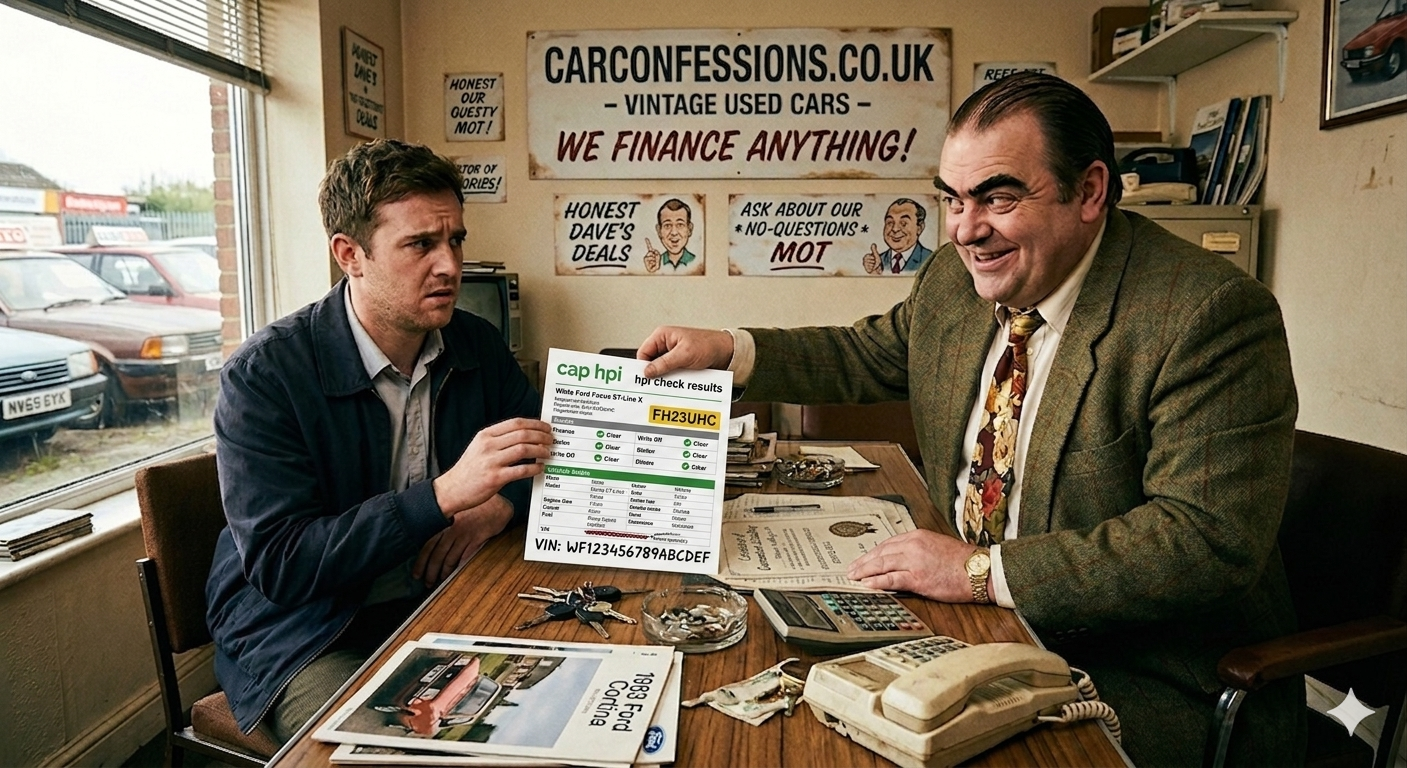
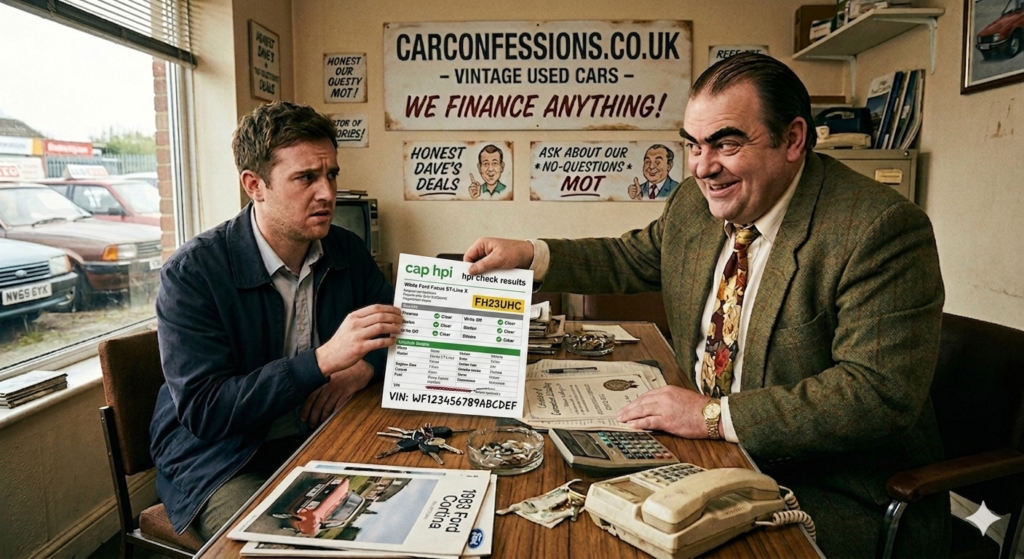
Among other things, I watched the sales manager produce HPI certificates for customer vehicles. Not run new ones. Produce them. Old checks, doctored, presented to customers as current. Checks that showed a clean result on a vehicle that — had the customer run their own — might have told a different story.
I don’t know how widespread this practice is. I can tell you it existed in at least one dealership I worked in, and I left quickly enough that I never found out what else was going on there. But I’ve never forgotten it.
The lesson is simple: always run your own HPI check. Never accept one from the dealer. It doesn’t matter how reputable they look. It doesn’t matter if they wave a printed certificate at you. It doesn’t matter if they act offended that you’d even consider running your own.
Run your own. A check costs less than £20. The guarantee that comes with it is worth considerably more. The peace of mind is worth more still.
If a dealer objects to you running your own check, that’s a reason to walk away, not a reason to reconsider.
The guarantee matters more than people realise
I mentioned this above but it’s worth dwelling on. When you buy an HPI check directly and it returns a clean result that later turns out to be wrong, you’re covered by their £30,000 guarantee.
That guarantee doesn’t transfer. It applies to the person who purchased the check. A certificate handed to you by a dealer — even a legitimate one — doesn’t carry the same protection for you as a buyer. You need your own purchase reference number to make a claim.
This alone is reason enough to always run your own, even if you trust the dealer completely.
What to do with the results
If the check comes back clean: good. Don’t stop there. You still need to check the service history, inspect the car properly, and ideally get a mechanic to look it over. The HPI check is the floor, not the ceiling.
If the check flags outstanding finance: walk away unless the dealer can prove the finance has been settled and provide documentation. Don’t take their word for it. See the paperwork.
If the check shows a Cat S or Cat N write-off: it’s not automatically a dealbreaker, but the price needs to reflect it and you need to know the repair was done properly. Get it inspected by an independent mechanic before you commit.
If the check flags a stolen marker or a cloned plate: walk away immediately. Don’t negotiate. Don’t give the seller time to explain. Leave.
The confession
The dealership I lasted two weeks at is no longer trading. I looked them up a while ago, mostly out of curiosity. I wasn’t surprised.
I’ve thought about those customers occasionally. The ones who were handed a certificate and believed it, because why wouldn’t you? They were buying from a dealer. Dealers are supposed to be trustworthy.
Some are. Some aren’t. The ones who aren’t tend to look exactly like the ones who are.
Run your own check. Twenty quid. Every time. No exceptions.
Run an HPI check on your vehicle →
If you found this useful, have a look at the 7 checks every used car buyer should run before handing over a penny — the HPI check is one of them, but there are six more that are just as important.