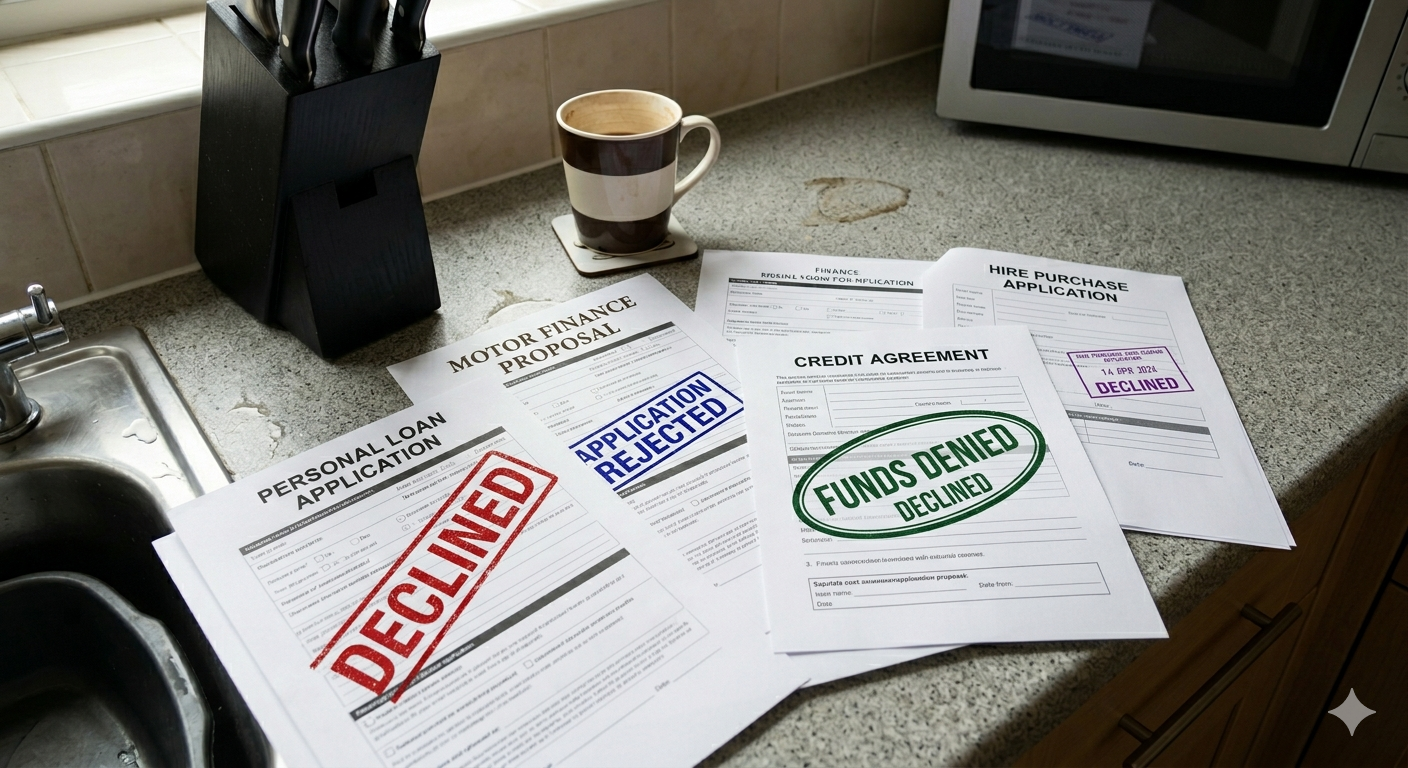
Finance rejected? Why dealers say no (and what to do about it)
Finance Rejected? Don’t give up
You’ve found the car. You’ve done your checks. You’ve negotiated the price. You fill in the finance application and sit back, confident. Three days later, the dealer rings with bad news: finance rejected.
Your credit score wasn’t good enough. You’ve got too many applications on file. Your income doesn’t match your expenses. You’ve missed payments in the past. You’re a financial liability, apparently.
But here’s what I learned in two decades of car finance rejections, it isn’t the end of the story. It’s the beginning of a conversation the dealer.
Why Banks Say No (The Official Reason)
When a finance company rejects an application, they’ll cite the usual suspects:
Credit score too low. You’ve had defaults, missed payments, County Court Judgements, or you’re just new to credit. Banks see risk. They see a statistic: people with poor credit histories default more often. So they say no.
Debt-to-income ratio too high. You earn £25,000 a year but you’ve got £15,000 in existing debts. A £300/month car payment stretches you too thin. The maths don’t work.
Not enough credit history. You’re young, you’ve never borrowed before, or you’ve just moved to the country. The bank has no data. No data equals no certainty. No certainty equals no.
Employment instability. You’ve changed jobs twice in two years. Freelance work looks dodgy on an application. Zero-hours contracts are a red flag. The bank wants a salary, a permanent contract, and proof you’ll still be employed in 12 months.
Too many recent applications. Every time you apply for credit, it leaves a mark on your file. Multiple applications in a short period scream desperation. Banks think: if he’s applying everywhere, someone must have already said no.
Existing arrears or defaults. You owe money you haven’t paid. Whether it’s £50 on an old phone bill or £500 on a credit card, the bank sees it as a harbinger of things to come.
These are the reasons they tell you. They’re not wrong. But they’re also not the whole story.
Why Dealers Say Yes (The Real Reason)
Here’s what you don’t know: finance rejection isn’t the end for the dealer either.
When a high street bank says no, the dealer doesn’t give up and send you home. They move you to a specialist lender — a finance company that exists specifically to approve people the banks won’t touch. These companies make their money on volume and higher interest rates. They take more risk. And they’ll approve people with credit histories that would make a bank manager weep.
You’ll pay for it, though. Where a good credit score might get you 5% APR, a bad one could cost you 25–35% APR. That £15,000 car financed over 48 months suddenly costs you £19,000 in total interest. But you get the car. APR isn’t the full picture either – look at the differences between PCP and HP here
The dealer doesn’t care which finance company approves you — high street bank or specialist lender. They make their money on commission. Every application they submit, they get paid. And every finance deal they complete, they make a percentage of the interest generated.
So here’s what actually happens:
- You apply with a high street bank. Finance Rejected.
- The dealer submits your application to three specialist lenders simultaneously.
- One of them says yes, but at 28% APR.
- You either accept or you don’t.
But there’s a catch that nobody tells you about.

The Confession: The County Court Judgement That Still Got Approved
I had a customer — let’s call him Steve. Mid-fifties, decent bloke, working as a mechanic. He came in wanting a van for cash-in-hand work. He needed the finance to bridge a gap before he got some bigger contracts.
His credit was shot. Not just bad — catastrophic. Defaults, missed payments, the works. And on top of it all, he had a County Court Judgement (CCJ) against him from a failed business venture five years prior. A CCJ is basically the kiss of death in credit terms. It’s a legal record that says: this person was taken to court for not paying their debts.
I submitted his application to our main prime lender. Finance rejected. Submitted to specialist lender number one. Finance rejected. Lender number two. Finance rejected. Lender number three was down to our last option, and they wanted security: proof of address, employment verification, the works.
Steve’s problem: he’d been moving around. He was living with his brother. The only proof of address he had was a summons for the County Court Judgement — literally a legal document telling him to appear in court because he owed money.
I told him to bring it in anyway. He thought I was insane.
We sent it to the lender. Along with his bank statements showing he was actually earning decent money as a mechanic. Along with his employment contract from his primary employer. And somehow — somehow — they approved him.
At 34% APR.
His van cost £12,000. Over 48 months at 34%, he paid £17,600 in total. That’s an extra £5,600 because of his credit history. And because he had a CCJ outstanding.
But here’s the kicker: the finance company approved him because they could see he was earning money. Not because his credit was good. Not because the CCJ had disappeared. But because the maths showed: this person is currently generating income that covers the payment.
They were taking a punt. And they made their money on the interest rate.
What Finance Rejection Actually Means
When a dealer tells you that you’ve been “rejected,” what they mean is: the first lender said no. They don’t mean: nobody will lend to you. They mean: the cheap money isn’t available.
The question is: do you want the car badly enough to pay for it?
If you’ve been rejected by the high street bank, here’s what you need to know:
You’re probably going to be approved by a specialist lender. They approve people with defaults, CCJs, missed payments, and dodgy employment. They exist for this. The trade-off is the interest rate. You’ll pay a lot more.
Your income is what matters. I’ve approved people with terrible credit if their bank statements showed they were earning money. The lender doesn’t care if your credit history is a disaster if your current income can cover the payment. They’re betting you’ll keep earning. If you stop earning, you’ll miss a payment, and they’ll repossess the car and sell it to recover their losses.
Employment verification is critical. A permanent contract at a stable job is worth more than a higher salary at a job you’ve been in for three months. Stability = income predictability.
Each application damages your credit score. Every time a lender does a “hard search” on your file, it leaves a mark. Multiple marks in a short period scream desperation and make approval harder. So dealers will typically submit to multiple lenders simultaneously — one search from each lender. But if you’re going from dealer to dealer, applying independently, you’re stacking up searches.
Specialist lenders are real lenders. They’re not loan sharks. They’re licensed finance companies. They follow the same regulations as the high street bank. The difference is their risk appetite. They’ll approve you, but they’ll charge you more, and they’ve got robust repossession policies.
The interest rate is negotiable. Not always, and not much, but sometimes. If you get an approval at 28% APR and you know you can get approved elsewhere at 25%, you can use that as leverage.
What to Do If You Get Rejected
Don’t accept finance rejection as final. Tell the dealer you want them to submit to specialist lenders. If they say they can’t or won’t, change dealers.
Get proof of your income. Bank statements, payslips, contracts, tax returns — anything that shows you’re earning money. The most persuasive document in a finance application isn’t your credit history. It’s evidence that you’re currently generating income.
Be honest about employment. If you’re self-employed, have receipts and accounts. If you’ve just changed jobs, bring your new contract. If you’re on zero-hours, bring your last three months of bank statements showing actual earnings. Lenders understand modern employment. What they don’t understand is evasion.
Don’t apply multiple places independently. Each application damages your score. Use one dealer and ask them to submit to multiple lenders. One hard search per lender is the standard. Don’t do five hard searches at five different dealerships.
Know your interest rate ceiling. Specialist lenders have different risk appetites. APRs for bad credit typically range from 20–35%. If someone’s offering 45%, shop around. If no one will lend at any rate, your credit history is genuinely problematic, and you should consider saving for a cash purchase instead.
Understand what you’re paying for. If your APR is 28% instead of 5%, you’re paying a risk premium. That’s the cost of your credit history. It’s not a con. It’s the cost of the money. If you can’t stomach it, don’t take it. This isnt a scam like discretionary finance commission – see my thoughts on that one here
The Real Game
Here’s what the dealer won’t tell you: finance rejection is rarely about whether you’ll get approved. It’s about how much you’ll pay for that approval. The game isn’t “approved or rejected.” The game is “what interest rate can we charge you?”
The bank says no because the margin is too thin at 5%. The specialist lender says yes because they can charge you 28%. Both are making rational decisions based on risk. You’re the variable. Your current income, your employment stability, your ability to keep paying — that’s what determines whether you’re approvable.
Steve got his van. He paid 34% APR because he had a CCJ and a dodgy credit history and was living with his brother. But he had a job, bank statements proving income, and a contract showing he was employed. The finance company bet that he’d keep earning. He did. He paid off the van. His credit history improved. He never defaulted.
The lender made money. Steve got the van. And I made my commission.
The only person who lost? Steve, because he paid £5,600 extra in interest. But he got the van he needed to earn money he couldn’t earn without it. So from his perspective, it was a trade worth making.
Just make sure you know what you’re trading.
Buying a used car? Don’t forget: