Why Dealers Want You Thinking About Monthly Payments (Not the Price)
By Frank Butcher · Dealer Tactics · 29 April 2026
There’s a number that lives rent-free in my head from my days as a business manager on the forecourt.
£1.87. The price of a pint of beer. The cost of not paying attention.
That was my figure. The amount I’d aim to be over a customer’s target weekly payment when I presented the finance deal. Not under. Not matching it. £1.87 over.
Why £1.87? Because when I first started using it, that was the price of a pint of beer. And if I could get a customer to shrug and say “yeah, go on then” at the cost of one extra pint a week, I’d won.
Except it wasn’t just a pint a week. Not really.
Here’s what most customers never worked out: they thought in round weeks. Four weeks to a month, twelve months to a year. Tidy. But that’s not how monthly payments work. A monthly payment is a weekly figure multiplied by 4.333 — because there are 52 weeks in a year, not 48.
So £1.87 a week sounds like £7.48 a month. It’s actually £8.10. And over a five-year finance term, that single extra pint a week adds up to £486.57.
I’m not in the trade any more. But if I was still selling cars today, my figure would be £4.40 — the current price of a Costa coffee. And the number at the end of that five-year agreement?
£1,143.96.
The trick hasn’t changed. Just the drink.
This is how the monthly payment game works. And once you understand it, you’ll never walk into a dealership the same way again.
Thirty years of inflation. The same monthly payment.
Here’s something that should make you stop and think.
When I started in the trade in the late eighties, a typical new car — your Ford Escort, your Vauxhall Cavalier, a solid family motor — cost somewhere between £7,000 and £9,000. Finance back then was straightforward HP: borrow the money, pay it back over two or three years, own the car at the end. A typical monthly payment was around £250.
Fast forward to 2019. Cars had changed beyond recognition. The average new car was pushing £25,000 to £28,000 — three times the price in cash terms. And yet, the average monthly finance payment was still hovering around £250.
Same number. Three times the car price. How?
PCP happened. Longer terms happened. Balloon payments happened. The industry had spent three decades developing ever more sophisticated financial products specifically designed to keep the monthly number feeling manageable — while the total amount you owed quietly ballooned in the background.
Then COVID hit, supply chains broke, used car prices went through the roof, and the illusion cracked. By the mid-2020s, average monthly payments had climbed to around £300–£400 — not because the tricks stopped working, but because even the tricks couldn’t absorb what had happened to car prices.
The monthly payment had always been a magic trick. COVID just made it harder to perform.
To put it another way: if £250 a month in 1988 had simply risen with general inflation, it would be worth around £750 today. Cars didn’t get that much more expensive in real terms — but the finance got a lot more complex to make sure you never noticed.
Why dealers lead with monthly payments, not prices
Ask a dealer how much a car costs and they’ll often answer with a question: “What sort of monthly budget are you working with?”
That’s not helpfulness. That’s misdirection.
The moment the conversation shifts from “what does this car cost?” to “what can you afford per month?”, the dealer controls the frame. And in that frame, the actual price of the car becomes almost irrelevant — because almost any price can be made to look affordable if you spread it thinly enough.
A £20,000 car sounds expensive. £350 a month doesn’t — even though you might end up paying £25,000 by the time the finance agreement runs its course.
The monthly payment isn’t the cost of the car. It’s a lever. And dealers are very good at pulling it.
The four ways a payment gets manipulated
For a period — before the FCA got involved and banned the practice — finance managers like me had discretionary commission arrangements. We could set the interest rate within a range, and earn more commission the higher we pushed it. The rate was always part of the calculation: higher rate on a shorter term, lower rate on a longer one. We’d move the dials until the monthly payment landed where the customer wanted it.
When I was working as a business manager, I had four tools I could reach for whenever a customer’s target monthly payment didn’t quite line up with the deal I was trying to do.
1. Extend the term
The simplest trick. Spread the same amount over a longer period and the monthly payment falls. A £15,000 car over 36 months at 9.9% APR costs around £477 a month. Stretch it to 48 months and it drops to around £373. Same car, same price, same rate — but suddenly it “fits the budget.” What you’re actually doing is paying more total interest and staying in debt for longer. But the monthly figure looks better, so customers often didn’t ask too many questions.
2. Adjust the rate
3. Take a payment upfront
This one sounds helpful. “If you put a little something down upfront, I can get that monthly down for you.” What they’re actually asking you to do is put in a larger deposit — reducing the amount financed, which reduces the monthly cost. The car hasn’t got cheaper. You’ve just paid more of it upfront. Sometimes that’s perfectly sensible. But it was often presented as a favour when really it was just moving money from one pocket to another while the deal stayed intact.
4. Adjust the balloon payment (PCP)
On a PCP deal, there’s a final lump sum — the Guaranteed Minimum Future Value — that you either pay to keep the car, hand back, or roll into your next deal. Increase that balloon and the monthly payments fall, because you’re deferring more of the cost to the end. Customers liked lower monthlies. So sometimes the balloon went up. And three years later, when they couldn’t afford to pay it and couldn’t roll into a new deal, they found themselves in a bit of a bind.
The 4.333 problem — and why a Costa a week costs you over a grand
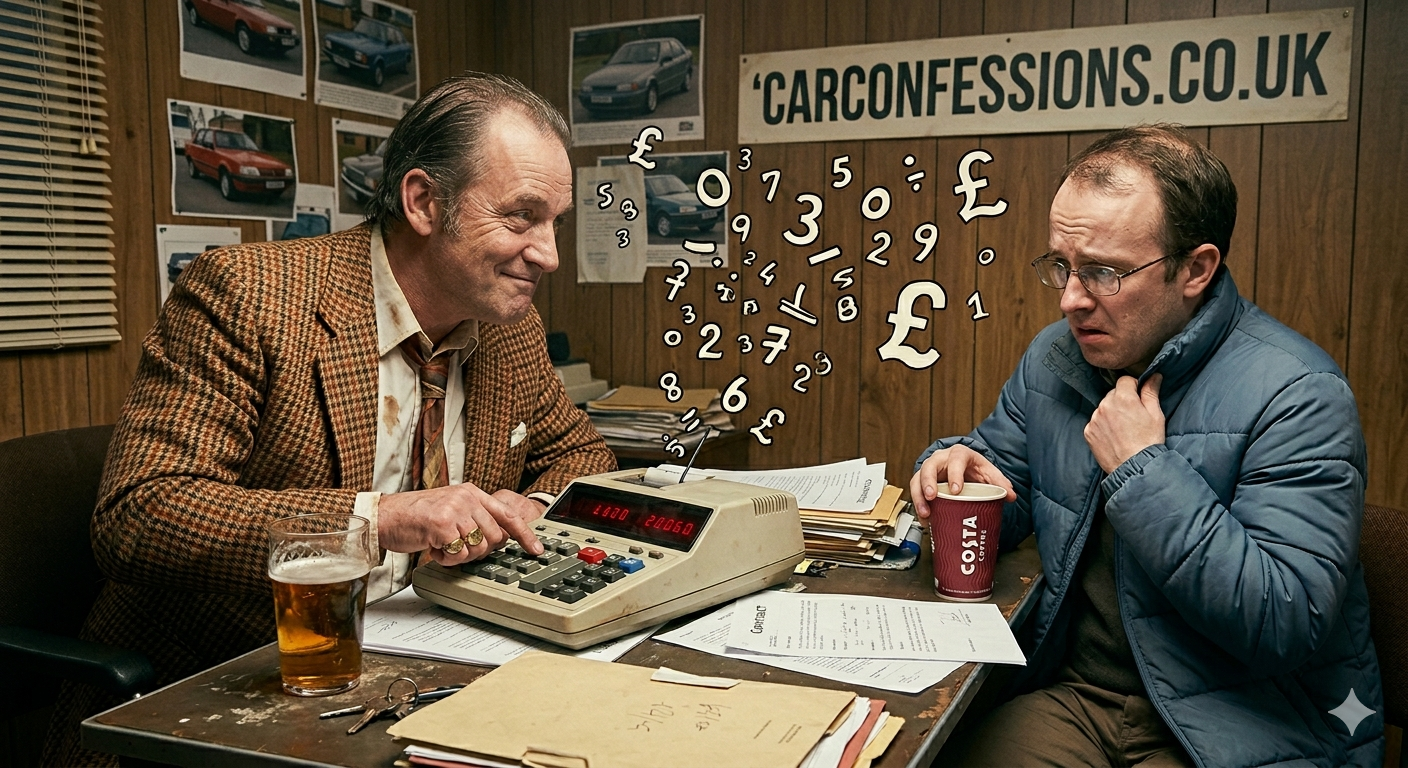
Most people can’t do this maths in their head, and dealers know it.
When a customer told me their budget, they almost always thought in weekly terms — because that’s how wages work, how rent works, how most people actually experience money. So I’d present the finance in a way that felt weekly, even when the payments were monthly.
And almost nobody knew that a month isn’t four weeks. It’s 4.333 weeks. The difference between those two numbers is where a lot of quiet profit lived.
Back then, £1.87 a week felt trivial. “Less than a pint, honestly.” Today, £4.40 still feels trivial — it’s just a Costa. But the monthly payment isn’t £17.60 higher (£4.40 × 4). It’s £19.07 higher (£4.40 × 4.333). And over five years, that’s £1,143.96. Not from the interest rate. Not from the price of the car. Just from the gap between how customers think about time and how the calendar actually works.
I used a small, relatable number because it was below the threshold where anyone would push back. It felt like rounding, not a decision. That was entirely the point.
How to protect yourself
Always negotiate on the total price first
Before finance is even mentioned, agree the price of the car. Get it in writing if you can — even a note on a business card. Once the price is fixed, the finance conversation is much harder to manipulate, because any change to the monthly payment has to be explained.
Know what the total cost of credit is
Every finance agreement must legally show you the total amount payable — that’s everything you’ll have paid by the end of the agreement, including all interest. Find that number. Compare it to the price of the car. The difference is what the finance is actually costing you.
Set your budget before you go in — but don’t lead with it
Know your number. But if you tell a dealer your monthly budget before you’ve agreed a price, you’ve handed them the map. They’ll work backwards from that figure to build a deal that suits them, not you.
Be suspicious of “I can get that down for you”
Whenever a dealer offers to reduce your monthly payment without explaining how, ask exactly how. Is the term getting longer? Is more money going in upfront? Is the balloon going up? Every dial they turn has a cost somewhere.
Convert weekly to monthly properly
If anyone frames a payment as a weekly figure, multiply it by 4.333 — not 4 — to get the true monthly cost. The difference between those two numbers is exactly where my pint money lived.
If you’re VAT-registered and self-employed, ask about contract hire
If you run your own business and you’re VAT-registered, a contract hire deal may allow you to reclaim 50% of the VAT on the monthly rental — and potentially more depending on how the vehicle is used. Your accountant will know the exact rules. The point is: the finance conversation looks very different for a sole trader than it does for a private buyer, and most dealers won’t volunteer that information unless you push them.
A note on the commission scandal
Worth reading separately
The adjustment of interest rates by finance managers is connected to the wider discretionary commission story — the one that’s currently generating billions of pounds in potential compensation claims against lenders.
My view on that is more complicated than the headlines suggest. If you want the full picture — including the part nobody’s talking about — I’ve written about it here: The Car Finance Commission “Scandal.” Or Did You Really Think We Were Doing It for Free?
The short version: if you took out car finance between 2007 and January 2021, you may be entitled to a refund. Claim through your lender directly, or via the Financial Ombudsman Service. You do not need a claims management company — and I’d strongly suggest not using one.
The bottom line
The monthly payment conversation is designed to make you feel like you’re in control of the deal. You’re not — not unless you’ve already locked in the price.
The industry spent thirty years perfecting financial products designed to keep that monthly number feeling manageable. The number stayed flat. The debt quietly grew. And customers drove off the forecourt feeling like they’d got a good deal.
In 1988 my figure was the price of a pint of beer — £1.87. Across a five-year agreement, that was nearly £500. If I was still on the forecourt today, my figure would be a Costa coffee — £4.40. Across the same five-year term, that’s over £1,100. The trick is the same. Only the menu prices have changed.
Now you know.
Frank’s Confession
One of my favourite customers was my old maths teacher. He came in with his wife, who was self-employed — a sole trader, VAT-registered. Sharp pair.
I spent forty minutes going through the numbers on a contract hire deal. Proper numbers. The 50% VAT reclaim on the monthly rental. The way the payments worked differently for a self-employed buyer versus a private one. The tax treatment. The total cost of credit versus the net cost after the VAT recovery. I drew it out on a notepad.
His wife got it immediately. He took a little longer — but he got there.
They bought the car. Contract hire, structured exactly as I’d outlined. A good deal, genuinely.
And yes — I still slipped in the £1.87.
On the way out, he shook my hand and said: “I have to say — you could never do maths like that at school.”
“You never paid me to do maths like that at school.”
He laughed. His wife did not.
If this rang any bells, drop a comment below — I’d genuinely like to hear it. And if you’re heading to a dealership soon, read how to negotiate the price of a used car before you go. The two go hand in hand.