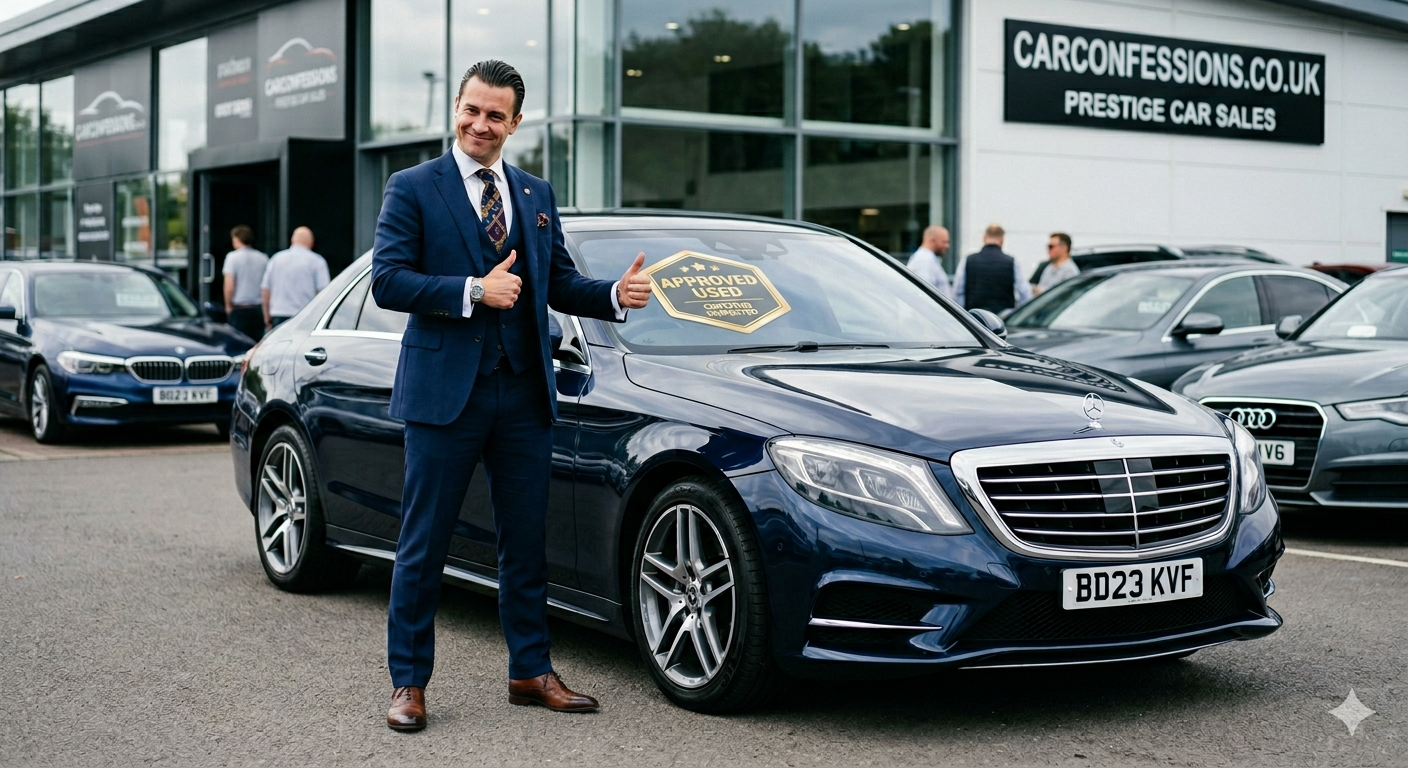
Approved Used Cars: What the Badge Actually Means (and What It Doesn’t)
Approved Used cars are sold to you as the safe option. The reassuring option. The one your mother would approve of. A car that’s been hand-picked, scrutinised, polished and presented for your approval by the manufacturer themselves. Not some dodgy backstreet operation. The proper stuff.
I sold a lot of Approved Used cars in my time. And I’m here to tell you what the badge actually means — because most buyers walk onto a manufacturer forecourt with an assumption in their head that simply isn’t true.
The assumption goes something like this: “If it’s Approved Used, the manufacturer is standing behind it. They’ve checked it properly. It’s basically as good as new.”
It isn’t. Not quite. Not even close, in some cases.
This isn’t to say Approved Used is a scam. It isn’t. There are genuine benefits and I’ll get to those. But the gap between what buyers think they’re getting and what they’re actually getting is one of the most consistent blind spots I saw in twenty-odd years on the forecourt. And it’s a gap the dealer is more than happy to leave unexplained.
What buyers think “Approved Used” means
When someone walks onto a BMW or Audi or Mercedes forecourt and sees the Approved Used badge in the windscreen, here’s what most of them are thinking — even if they couldn’t articulate it:
- The manufacturer has personally inspected this car
- It’s been mechanically rebuilt to near-new standard
- Any problems have been fixed before sale
- It comes with a proper manufacturer warranty
- It’s been “approved” by some kind of central authority
I want you to read those five points again, because every single one of them is either wrong, partially true, or has a caveat the size of a Range Rover attached to it.
What “Approved Used” actually means
An Approved Used car is a car the dealership has decided to put through that manufacturer’s used car programme. That’s it. That’s the headline.
The dealership — not the manufacturer — does the work. The dealership runs the checks. The dealership signs the paperwork. The manufacturer provides the framework: a list of things the dealer must check, a minimum warranty they must offer, a set of cosmetic standards the car must meet, and a badge they’re allowed to stick on the windscreen once the box is ticked.
That framework varies wildly between brands. And that’s the bit nobody tells you.
BMW Approved Used
BMW Approved Used cars get a multi-point check (the exact number changes with the marketing cycle but it’s somewhere north of 100), a minimum twelve-month BMW warranty, twelve months breakdown cover, and an HPI check. The warranty is the real deal — it’s a proper BMW-backed warranty, not a third-party policy with the BMW logo bolted on.
It’s a genuinely decent programme. But the checks are still done by the dealer’s workshop, not by a roving BMW inspector. And the threshold for “passing” the inspection is “fit to sell as Approved Used,” not “as good as new.”
Audi Approved
Audi Approved is structurally similar — multi-point inspection, minimum twelve-month warranty, HPI check, breakdown cover. Again, dealer-administered. Again, genuine warranty backing.
What Audi Approved doesn’t do — and what most buyers assume it does — is mean the car has had every consumable item replaced. Worn brakes that are above the legal minimum stay on the car. Tyres at 3mm get sold to you at 3mm. Service history gaps don’t disqualify the car, they just get noted on the paperwork.
Mercedes-Benz Approved Used
Same structure. Slightly different number of checkpoints in the inspection. Same fundamental point: it’s a dealer-administered programme operating to manufacturer minimums.
Ford Direct
Ford Direct is the Ford volume-brand equivalent and it’s noticeably lighter than the prestige programmes. Shorter minimum warranty period in most cases, less aggressive cosmetic standards, and a check list that’s more focused on safety and roadworthiness than on bringing the car back to showroom condition.
That’s not a criticism. Ford Direct is priced accordingly. The problem is when buyers assume Ford Direct means the same thing as BMW Approved Used. It doesn’t. The badge looks similar. The reassurance lands the same way. The substance behind it is different.
Vauxhall Network Q, Toyota Approved, Volkswagen Das WeltAuto, Nissan Intelligent Choice
All variations on the theme. All worth reading the actual programme details on rather than assuming. The marketing pages all use the same handful of words — “rigorous,” “comprehensive,” “thorough” — and the underlying programmes differ in ways the marketing doesn’t make clear.
The things Approved Used does genuinely give you
I’ve been brutal about the gap between perception and reality. Let me be fair about what you actually get when you buy Approved Used:
A proper warranty. This is the big one. A manufacturer-backed warranty from an Approved Used scheme is materially better than a third-party warranty from an independent dealer. The claim process is easier. The repairs happen at a franchised dealership with manufacturer parts. There’s no haggling about whether the part counts as “wear and tear.” Or rather, there is, but it’s less aggressive than the haggling you’d get with a budget warranty provider.
An HPI check has been done. Don’t let this stop you running your own — I’ve written separately about why you should never trust the dealer’s HPI check — but the dealer having done one means they’re standing behind the legal status of the car. If they sell you a clocked or stolen Approved Used car, the manufacturer programme is on the hook in a way it isn’t with independent stock.
A baseline standard of presentation. The car will have been valeted properly. The cosmetics will be at or above a defined standard. The tyres will be legal. The brakes will be legal. You’re not getting a sparkling new car, but you’re not getting a car with bald tyres and a chip in the windscreen either.
Some kind of return policy. Most manufacturer programmes include a short return window — typically 14 to 30 days — where you can change your mind. Independent dealers don’t have to offer this. The Consumer Rights Act gives you 30 days to reject a faulty car regardless, but Approved Used schemes are usually more flexible about non-fault returns.
Breakdown cover. Almost all the schemes throw in 12 months of roadside assistance. It’s worth £100 or so on the open market.
The things Approved Used does not give you
Now the bit the salesman won’t volunteer.
It does not mean the car has had any major work. If the brakes were 60% worn when the car came in, they’re still 60% worn when you drive it out. If the timing belt is due in 5,000 miles, it’s still due in 5,000 miles. The Approved Used inspection is a roadworthiness and presentation check, not a refurbishment.
It does not mean the previous owner was a saint. Approved Used cars come from the same pool as any other used car. Lease returns, ex-demonstrators, part-exchanges, fleet cars. The history of the car is whatever the history of the car is — the badge doesn’t change it.
It does not mean you’re getting a fair price. This is the big one. Approved Used cars are almost always priced at a premium — sometimes 10-15% above the equivalent non-Approved car at an independent dealer. Some of that premium is justified by the warranty and the peace of mind. Some of it is pure brand tax. Knowing which is which is your job.
It does not protect you from negotiation. The price on the windscreen is not the price you have to pay. The fact that the car is Approved Used doesn’t mean the dealership has lost the ability to do a deal. There’s still room to negotiate — and the dealer expects you to try.
It does not mean every Approved Used dealer is honest. Approved Used dealers are franchised dealerships, which means they operate under manufacturer rules. But the people on the floor are still salespeople, paid on commission, working to targets. The same tactics get used on Approved Used forecourts as get used everywhere else. The carpet is nicer, the coffee is better, the script is the same.

The bit they really don’t want you to think about
Here’s the question I would ask anyone considering buying an Approved Used car: what would this same car look like if it weren’t Approved Used?
Because most Approved Used cars exist in two versions. There’s the version sitting on the franchised forecourt with a 12-month warranty, a valet, an HPI check, a windscreen badge and a £1,500 premium on the price. And then there’s the version sitting on an independent dealer’s forecourt three miles down the road — same make, same model, same age, same mileage — without the badge, without the manufacturer warranty, and £1,500 cheaper.
The £1,500 question is: what does the badge add to your life?
If the car is a complex prestige vehicle that’s expensive to repair, the answer is probably “a lot.” A BMW Approved Used warranty on an X5 that’s about to need a turbo replacement is worth every penny of the premium. The car is going to cost you whatever a turbo costs whether or not it’s under warranty, and a manufacturer-backed warranty will pay for that.
If the car is a five-year-old Fiesta, the answer is probably “not much.” A Fiesta is cheap to repair. A third-party warranty from a decent independent dealer costs a tenth of what you’re paying in Approved Used premium. The badge is selling you peace of mind you don’t actually need.
The Approved Used premium scales with the price of the car. The benefit doesn’t. That’s the maths nobody on a manufacturer forecourt is going to walk you through.
What to actually do
If you’re considering an Approved Used car:
- Read the actual programme details for that specific manufacturer. Not the marketing page. The terms and conditions. They’re all online. They tell you exactly what’s covered and exactly what isn’t.
- Compare the price to the non-Approved equivalent. Same make, model, age, mileage, specification, on Autotrader. Work out what you’re paying for the badge.
- Calculate what the warranty is actually worth to you. Get a quote for a 12-month third-party warranty on the same vehicle. The difference is what you’re actually buying.
- Run your own HPI check. Always. Approved Used or not.
- Negotiate. The price is negotiable. The extras (warranty extension, service plan, breakdown cover) are negotiable. The trade-in value is negotiable — though, as I’ve said before, don’t bring up the trade-in until you’ve agreed the car price.
- Don’t pay for what you don’t need. If you’re buying a £6,000 supermini, you don’t need a £400 service plan. If you’re buying a £40,000 prestige saloon, you probably do.
The confession
I sold an Approved Used scheme for a manufacturer I’m not going to name. And I sold a lot of cars on the strength of the badge. Customers would come in looking at an independent dealer’s car across the road, and they’d end up buying mine instead — same age, same mileage, more money — because the windscreen badge meant something to them.
It meant something to me too. It meant my commission was higher, my targets were easier to hit, and my month-end figures looked better.
The honest answer about Approved Used schemes is this: they’re not a con, but they’re not a guarantee of quality either. They’re a structured insurance policy with a manufacturer’s name on it, sold at a premium, on cars that are mostly just used cars with a slightly nicer valet.
Whether that premium is worth it depends entirely on the car, the alternative, and what your own appetite for risk looks like. Sometimes it absolutely is. Sometimes it absolutely isn’t. Knowing the difference is the bit the badge doesn’t help you with.
That’s what the badge actually means. Everything else is marketing.
Got a question about an Approved Used car you’re looking at? Spotted a difference between what the brochure says and what the dealer is offering you? Tell me in the comments — I’d rather you ask before you sign than after.
One last thing on Approved Used cars: do your own homework before you ever set foot on the forecourt. Whatever an Approved Used cars salesman tells you about the inspection and warranty, cross-check it against the manufacturer’s published programme terms and run the registration through the official MOT history service. An Approved Used cars badge is a starting point for your own checks, not a substitute for them.
So are Approved Used cars worth it? Approved Used cars can be worth the premium when the inspection and warranty genuinely close the gap, but Approved Used cars are not automatically a bargain. The smartest buyers treat Approved Used cars as a starting point, compare Approved Used cars against private sales, and never assume the badge replaces their own checks. In short, Approved Used cars reward the buyer who still does the homework.